
A Coin Written in Code
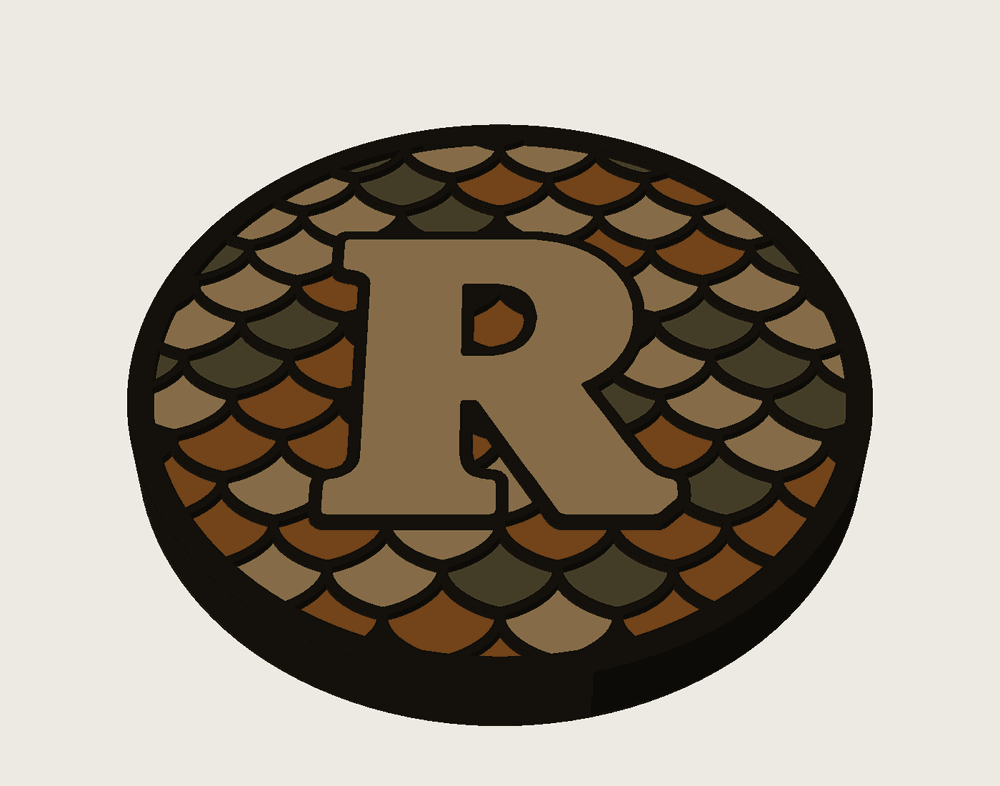
RigbyCo's visual signature is a field of scales: olive, tan, and orange scutes on a near-black ground, with a slab-serif R where it matters. We wanted that in a pocket. The target is a 35 mm coin, 3.5 mm thick, printed in four colors on a Bambu Lab X1C with a single AMS. Instead of sculpting it in a CAD program, we wrote it.
Why code instead of clicks
The scale pattern already exists as code. The brand's design system defines it as a generator — a seeded random layout of tapered scutes with fixed color weights — not as a drawing. Any hand-traced version would be an approximation of the real thing. So the coin is a CadQuery script: a page of parameters at the top, geometry below, and one run produces four color bodies, four STLs, and a STEP file in about eight seconds. Change a parameter, run it again, get a new coin. No modeling session, no un-doable history.
The port is faithful where it counts: the same random-number generator as the canonical pattern, the same seed, the same 40/35/25 olive-tan-orange weighting. One deliberate deviation — the canonical pattern's wavy, imperfect rows are switched off, because at coin size a straight grid reads cleaner. The R is traced to a polygon from the brand's official glyph mask, filled tan with a dark outline, not redrawn by eye.
The anatomy
What one run builds
The body. A 35.0 × 3.5 mm coin in the dark ground color, with a 1.2 mm rim. The back is flat — this is a one-sided coin by design.
The face. Scale fills sit recessed 0.6 mm deep while the rim, the R, its outline, and every line between scales stand 0.4 mm proud. The relief is the brand's "printed plate" look in actual plastic.
The count. 66 scale fills landed on this seed — 16 olive, 25 tan, 25 orange — and 14 slivers too small to print cleanly were left as ground color rather than forced in. Total volume: just over 3,100 mm³, most of it the body.

What's deliberately unsolved
A few questions are parked until the printer gets a vote. The scale outlines are drawn at 0.45 mm — close to a single nozzle width, which may prove fragile. The 3.5 mm thickness doesn't divide evenly into standard layer heights, which has consequences worth their own write-up. And the four bodies have only been assembled in a slicer, never extruded. We're saying so plainly: as of this entry the coin exists as toolpaths and arithmetic, not as an object.
The practical takeaway
If a brand element is specified as code, keep it as code all the way to the machine. The coin inherited the real pattern — same generator, same seed, same weights — because nothing was ever redrawn by hand, and every open question above can be answered by editing one parameter and running the script again. What the slicer said about those toolpaths is the next entry.